
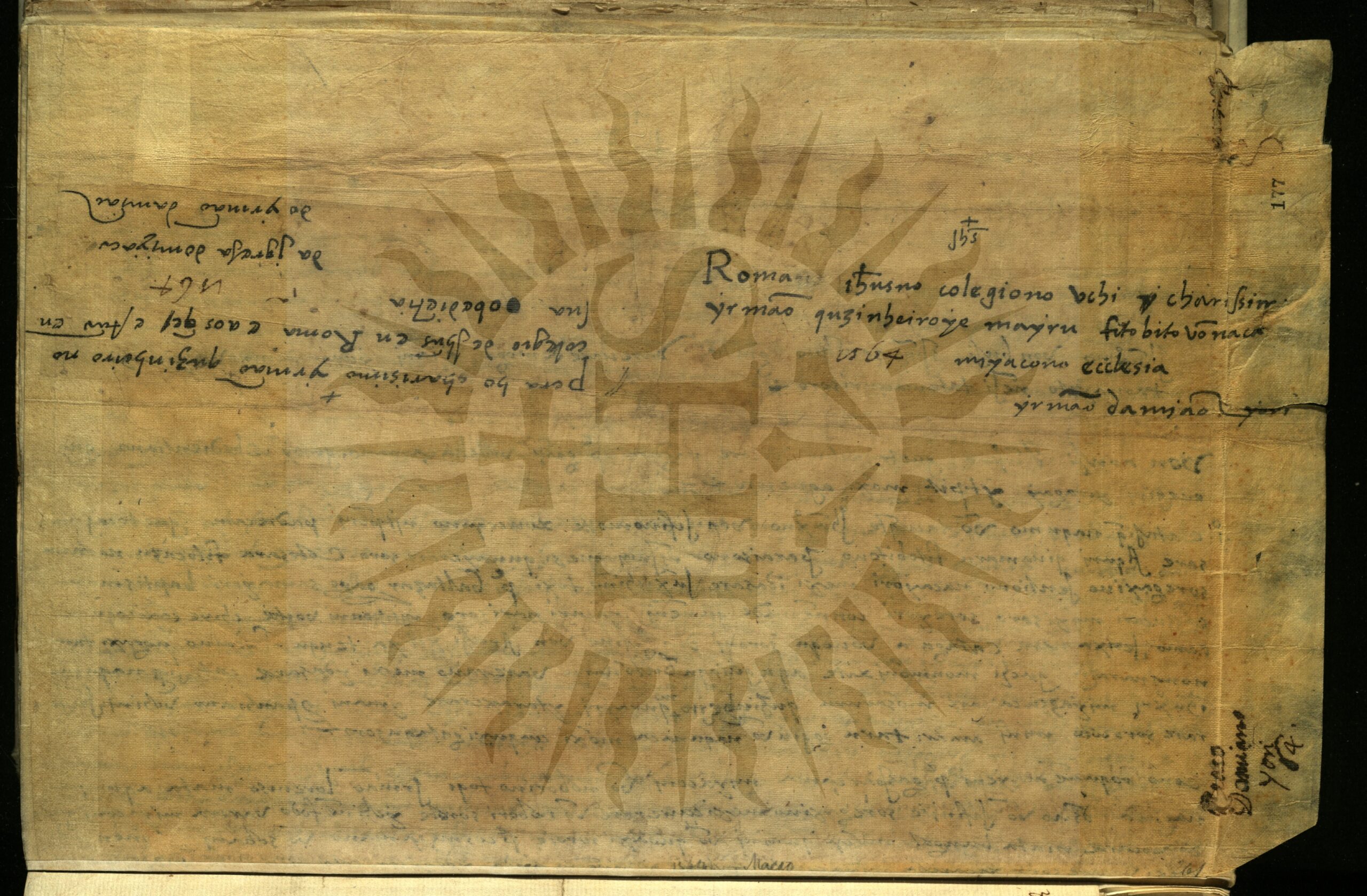

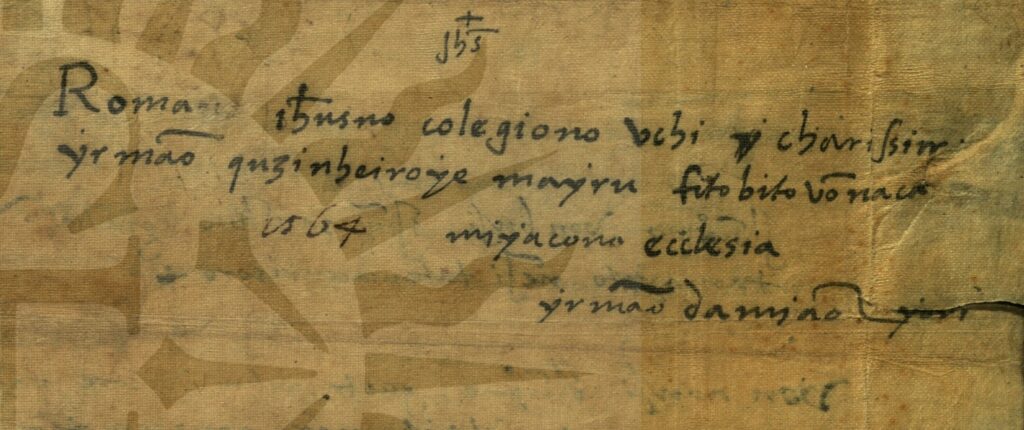
[Roma Iesus no colegio no uchi charissim yrmão quzinheiro ye mayru fitobito vō naca 1564 miyaco no ecclesia. yrmão damião yori]
Translation: To the respected people who have come to the dearest brother cook in the Jesuit college in Rome. From Brother Damião, at the Church of Miyako, year 1564.
When I first encountered this letter, among the sea of documents preserved in the Archivum Romanum Societatis Iesu, I was immediately intrigued. It was originally written in Japanese, but rendered using the Latin alphabet, which was then later translated (most likely with the assistance of a priest) into Portuguese. The subtle differences between the two versions revealed not only questions regarding translation, but the complexity of the writer’s experience of conversion. The author, “brother Damião,” was not an unfamiliar one. However, his writings were not very well known to me, or not nearly as much as the other names of priests and brothers that had authored hundreds of other letters in the Japonica-Sinica collection.
Maybe one of the most intriguing questions that the letter raised was its addressee: who was the yrmão quzinheiro, the cook of the Jesuit College in Rome, and just who were the “people who have came” to join him. Why would Damião make reference, in such a personal letter, to the “dearest brother cook,” and yet not call him by name?
About Damião
Baptized in 1555 at the age of seventeen, Damião of Akitsuki was a Japanese brother of the Jesuit mission to Japan, who was able to persuade merchants, warriors, and local lords to embrace Christianity, a faith brought from halfway across the globe. At a time when European missionaries could speak no more than a few phrases of Japanese, Damião allegedly would engage in complex debates with Buddhist monks and, by himself, visit towns and attest to the conversion of large groups of people.
In a letter dated March 6, 1565, Father Luís Fróis wrote of how he “was deeply pleased to witness the curiosity of four nobles from the household of the shōgun, who were making efforts to become Christians.” These men, he observed, memorized the teachings by writing them down in their own scripts, but before leaving they “compared what they had written with Damião to confirm its accuracy.” That same year, when the missionaries left the capital, “disheartening the Christian community,” it was Damião who offered guidance, encouraged perseverance in faith, and lifted their spirits by advising them to continue practicing and to nurture hope.
Two years later, in another letter, Fróis recounted that, while traveling together, Damião met a monk who had shown interest in Christian preaching. The monk, according to the letter, “wrote down the sermons he had heard in a book and showed them to Damião, asking for corrections.” The monk had once belonged to the Jōdo sect, but, according to Fróis, became disillusioned with its teachings on salvation. Damião, based on his own experience of conversion, was able to turn him towards Christianity.
However, despite his significant contributions to the evangelization of Japan, Damião has received little attention from historians, who have tended instead to credit the European missionaries with the successes of the early mission. It seems that no one has dared to raise an important question: who was he before joining the Society? Before becoming “Damião”? While it might prove quite difficult to find a definitive answer due to lack of sourcing, the question opens up a number of possibilities for interpreting Damião’s social role prior to his conversion, and how that role may have shaped his identity within the Jesuit mission. Clues lie especially in the Japanese portion of the letter, where we see how Damião began to reconcile his earlier, Buddhist understandings of “evil”, and align them more with the Christian framework of sin and salvation.
Before Becoming Damião
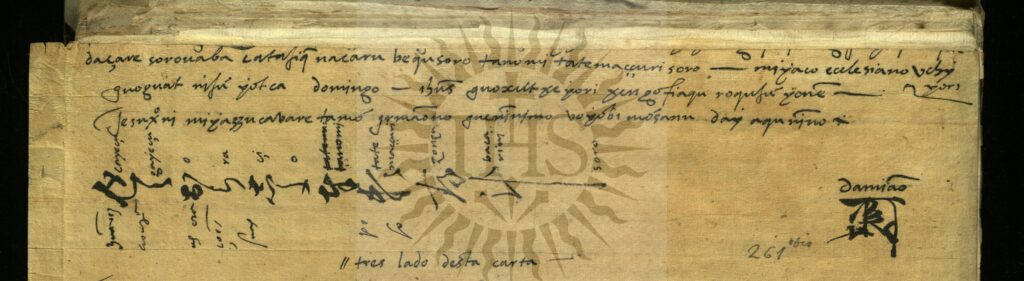
[Nitpon ni voite chiye caxicoqu xicamo jenxa naru catagata vo noqu soro ni dai jifi no von Aruji xetxa tengu fudai no nogaxi tamó nomi narazu, guchi monmô ni xite aquguiaqu butó naru varera uo mexi ydasare, catajiq naqu mo Jhu Xo ni miyazzucavare mósaruru quzinheiro no quray ni ytaraxerare yma ni Companhia no uchi ni júserare soro coto mi ni amari taru gogiú vô naqanaca móxi ççuquxi gataqu soro~.]
Translation: In Japan, even those who are wise are often cast aside, but by the great mercy of our Lord, not only was I, a hereditary captive of the Tengu, rescued, but we, who were ignorant and steeped in evil, have also been called. We are gracefully guided by Jesus Christ, and even someone like a cook may be accepted into the Society [of Jesus], a work so great that I cannot express it in words.
The vocabulary used within the letter shows a man keenly aware of his own transformation: he portrays himself as a “tengu-fudai” (天狗譜代), a hereditary captive of the Tengu, who found his release by the mercy of Jesus Christ. What precisely did “tengu-fudai” mean for Damião? Was he referring to the mountain-dwelling birdmen who appear in Japanese folklore as trickster figures, feared as demonic and revered as guardians? Or was he using a political idiom, that might have been used at that time to refer to the enemies of Buddhism? Rebels, proud monks, wanderers and even craftsmen… The fact that Damião used this term, “tengu-fudai”, to translate the idea of the Christian devil into a Japanese framework is intriguing. The translation would later reappear in other Jesuit writings, but this was likely one of its earliest occurrences in the context of the mission.
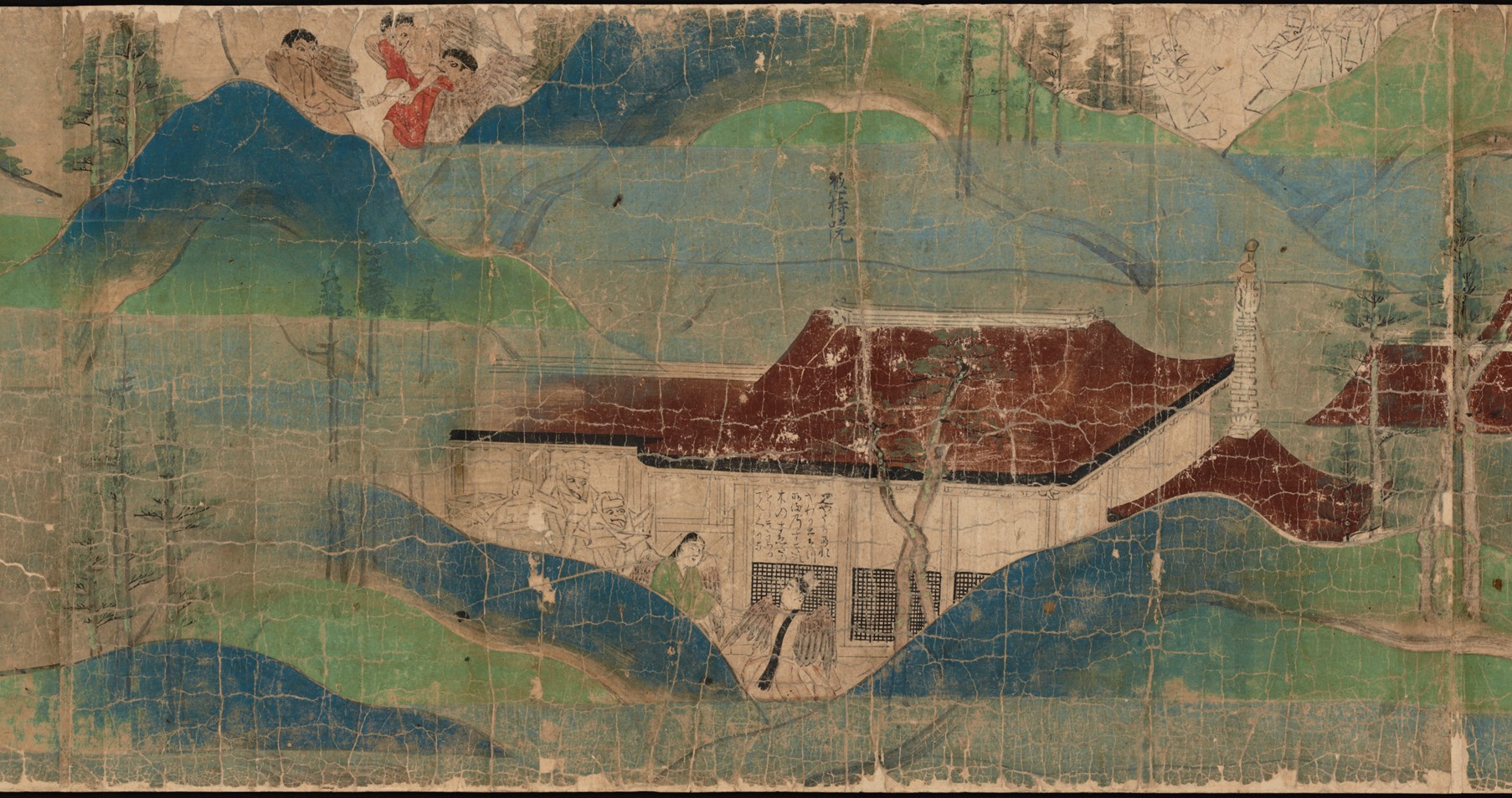

It is important to mention that, in early modern Japan, evil groups (akutō 悪党) were often associated with the treachery of the Tengu, and so were destined to damnation in the Tengu-dō (天狗道), a realm that lay outside the cycle of reincarnation. By saying that Jesus Christ was calling upon those who had ‘turned pathless’ by their evil deeds (aquguiaqu mudō 悪逆無道), those who could not be saved, Damião connected two distinct epistemological universes. In other words, he created a way to place Christ’s mercy in the logic of karmic reward and punishment, connecting the suffering of spiritual corruption and the hope of divine grace. Perhaps someone who believed they had no path to salvation would have recognized in these words a reflection of their own suffering. Damião saw in God’s mercy not only a release from a karmically burdened past, but also a chance to redirect his efforts toward a salvation that now felt within reach. We could even argue that the ability to articulate this logic was one of the most powerful tools of spiritual and epistemological transformation introduced by Japanese Christians.
It is also possible that this deep sense of guilt, his identification with a sinful past, offers insight into Damião’s social role before conversion. One probability is that he was closely tied to mountain dwellers or craftsmen, groups often weighed down by religious stigma. Akitsuki, the town from which Damião originated, was known for its population of yamabushi (mountain ascetics and warriors) whom Jesuit sources frequently associated with heretical or devilish practices. It is also possible that he served as a temple servant or cook, roles considered spiritually impure within local practices due to their association with taking the life of plants and animals. The fact that he would later take on the same role of cook within the Jesuit residence in Miyako (modern-day Kyoto), but with that position now reimagined not as a mark of karmic corruption, but as being a path to redemption shows how his conversion did not erase his former identity, but helped to transform its meaning.

This might offer an explanation for why his letter was addressed to the “brother cook”, as their shared histories was a reflection of his self-identification within the religious hierarchies. Both Buddhism and Christianity placed heavy emphasis on obedience. Damião’s use of the term Obedientia in the letter suggests that he may have viewed himself as only authorized to correspond with someone of equivalent status within the Jesuit order. Whatever his precise background, the weight of his “evil deeds” resonates throughout his writing, in a tone of one who knows the moral force of his past. Even his baptism name, Damião, which not only resembles the Portuguese word for Demon, but originally meant “to overcome” (δαμάῶ, damaō), reflects this dynamic.
Norms and Conversion
Despite having become one of the leading figures in preaching and converting, and even praised by the mission superiors for his virtue of obedience (“virtude de obedientia”), as well as his desire to mortify himself (“deseo de se mortificar”), Damião was, in the end, still bound. After his conversion, he repeatedly requested to take the Jesuit vows, as one letter notes, “because it seemed to him that he would be safer then, considering that he would be united with the body of the Company”, but his requests were always denied. The priests responded that Damião already had many responsibilities at home “first of all as a porter and a companion.” Even after being freed from the shackles of his former “evil nature,” Damião found his spiritual salvation bound by the rigid chains of obedience. Maybe the letter to Rome was also an indirect appeal, an attempt to testify to his efforts in the mission, to present his case, and to seek recognition from someone who understood his position and the people who would have joined him (as such letters were often read in the dining room).
This is to show how Damião was neither a blank-slate, nor a passive vessel for Christianity, but an active mediator of norms and emotions. He should be remembered as being much more than a simple translator of terms: he mapped Christian rites and teachings onto existing social and epistemological structures within Japanese society at that time. Yet for all his agency, Damião remains forgotten behind the many layers of Jesuit correspondence. This illustrates how, by taking the time to look at documents produced by the “converts”, we can more appropriately discuss the limited agency of the European missionaries and the crucial role the Japanese members played in reformulating Christian doctrine, which then allowed for its further spread.
Damião of Akitsuki’s uncertain past and his reconfiguration of local ideas within a Christian framework remind us that conversion was never a simple up-down transmission, but a process of “contractual colonialism”, filled with resistances and permanence. Jesuit priests may have brought universalist notions of salvation, but they also brought strict ideas of obedience and hierarchy. Damião’s letter to the cook stands as a testament to the complexities in the structural, moral, and metaphysical reshaping that often gets lost when we reduce the meaning of this change into the simple term, “conversion”.
Cite as: Laubenstein, Victor: A Letter to the Cook: Norms and Conversions in Early Modern Japan, legalhistoryinsights.com, 26.11.2025, https://doi.org/10.17176/20251201-105632-0
